Wednesday, October 20, 2021

City of Prince Rupert seeks services of a Utilities Coordinator

The busiest folks working at City Hall these days most likely are those handling the Job application desk, with the City once again putting up the Help Wanted Sign, this time with an opportunity in their Operations Department.

A Career opportunities posting for a Utilities Coordinator makes for the latest addition to the Operations Department team, the full time position, which is part of CUPE local 105 paying $41.79 per hour plus applicable premiums.

As the City describes it the work is varied and covers a wide range of duties.

This attendance sensitive position will be responsible for a wide range of duties including but not limited to, the inspection and repairs of all activities related to the operation, maintenance and construction of City infrastructure. 

The successful applicant will conduct utility investigations, perform CCTV inspections, generate appropriate reports and will be responsible for supervision of assigned staff. The successful candidate will be able to provide both surveying and computer drafting services to the Operations (Engineering and Public Works) Department. Computer skills, particularly with respect to engineering applications (inc. CAD and Civil 3D) are required. 

In addition, they will carry out day-to-day tasks stemming from requests for technical information, telephone enquiries, monitor selected capital expenditure programs and special projects. 

The successful candidate must meet the physical demands of the position and comply with safe work practices. The ability to work in a team and independently is required. Required to work overtime and weekend on call as operationally necessary as per Articles 19.03 and 25.07 of the Collective Agreement. 

This position must work toward, obtain and hold Level II Certification in Waste Water Collection and Water Distribution and applicable premiums will be applied.

It comes with a lengthy list of required qualifications, which you can review here.

The deadline for applications is November 4th.

After a bit of a lull at the start of the year, the City has been a frequent contributor to the Civic Info Job Bank a province wide employment listing page, having picked up the pace of job opportunities and we imagine hirings since June.

The latter something which doesn't gain quite as much information sharing as the job openings postings have in the past. With few in the way of welcome aboard notices, as was seen last week,  provided for other positions for the public to review.

You can review some of the past employment opportunities from our archive page here.


Stikine's Nathan Cullen speaks in defence of NDP government's Freedom of Information changes as part of extensive Tuesday debate


The British Columbia government found itself on the defensive for much of Tuesday, as the discussion on proposed changes to the Freedom of Information Act dominated much of the Legislature time in both the morning and afternoon session.

Citizens' Services Minister Lisa Beare must have felt somewhat like a swimmer in a Jaws movie, as the Liberals one after another joined into the discussion through Tuesday, challenging the Minister and the government on a range of areas of concern over their FOI plans.

Among those who spoke to the NDP government's narratives and raised some alarms when it comes to the legislation were interim Liberal leader Shirley Bond, former Liberal cabinet minister Todd Stone and former leader Andrew Wilkinson.

Minister Beare however was not alone on the day, there were reinforcements from the government side ready to lend a hand in defending the governments plans and among them were NDP MLA Nathan Cullen, with the Stikine member providing for a near thirty minute response to Liberal charges of the last 24 hours.

Some of the key elements from his presentation can be reviewed below:

It's a pleasure to join the conversation today about what I think we can all agree is an incredibly important topic — about how information is shared or not shared with the British Columbia public. And as somebody who also represents a northern riding, in Stikine, I am also thinking about the issues that we face up north — where, from time to time, citizens, citizen activist groups and local media seek to find out what is happening within government and will use this particular act in order to pull that information from government if it's not proactively disclosed. 

I think that's an important point to raise: that we should look over the trend line of our government — being now in power now some four years — to see if that trend has improved in and of itself. Are more parts of the British Columbia government automatically disclosing information to the public? 

Because where that is appropriate, that seems, to me, the most favourable situation, so that someone doesn't have to file a request, doesn't have to go and dig through mountains and mountains of documents. You can see that under our NDP government, we've increased the number of authorities. We've increased the number of institutions. 

Well, my friends across the way are certainly entitled to their opinions but not to their own facts. If the number of institutions are increasing — which they are, according to the commissioner and others — that are automatically disclosing their reports, are automatically disclosing information, that isn't appropriate, because we all know that there are limitations for disclosure and that there's also an expectation and a tension between privacy and disclosure.

Towards the bill, Mr. Cullen noted of the importance of moving forward with it and how information accessed from government sources is used.

This bill, Bill 22, B.C.'s Freedom of Information and Protection of Privacy Act, seeks to bring British Columbia forward in many important ways because, as members in the opposition and those on the government side have indicated, we've lagged a bit behind in terms of other jurisdictions within Canada, and in the way that we administer this act and the requests that come forward. 

Now I spent more than a fair share of my time in opposition. We would, from time to time, use freedom-of-information to try to get out information from government. It was sometimes successful. It was oftentimes thwarted by heavily redacted or government just taking so long that, by the time the information came forward, it was no longer useful. The issue had moved on. 

We've also seen, as opposition members here have talked about today, the great effectiveness that the fifth estate, the media, are able to use freedom-of-information — the power to draw from government more information than was initially disclosed, to be able to talk to the public about the administration and how the government is doing. 

I'm in full agreement with the opposition of the vital nature of freedom of information, particularly for the media — we'll focus on there for a moment — in terms of their efforts do their job on behalf of the public, because they have an incredibly important role to play in the public discourse, in keeping government accountable and making sure that the extraordinary powers that government has in its hands are handled responsibly.

Through the course of his remarks, the Stikine MLA outlined how important that access to Freedom of Information Act is, noting of recent high profile topics as the ICBC issues of the past and other areas in recent news reports where using FOI served to explore those themes more expansively.

Mr. Cullen also took to the topic towards what has been described by the NDP government as the modest fee being considered for the Access to information, using that to reflect on areas he suggested that the Liberal opposition as a group weren't so concerned about fees.

I've noted that some of the reports on Twitter which my Liberal friends are now using as sole-source information, are suggesting that places like Quebec don't have a fee at all, and in Ontario. There are sliding fees. 

There is an initial administration fee in many jurisdictions — $5, $10, $20, up to $25 — to suss out how extensive the request is. Are you asking for a single document? Are you asking for ten years' worth of documents and tens of thousands of pages? What is it that you're seeking?

And I think a $25 fee — up to and around that range, or as little as $5 — seems worthwhile in the sense that, we sometimes show the earnestness of requests connected to the fact of: will you put 5 bucks down? If someone is unwilling to pay $5, then are they sincere in their efforts? 

And our government is absolutely concerned and consumed with issues of equity and questions of social justice. I think we're in the $5 to $25 range over something like this. We're in what I would consider a reasonable range, and certainly reasonable with many other jurisdictions within Canada, the U.S. and around the world.

The Liberals have chosen today to obsess on the fees, and that's fine. Sometimes they're concerned about fees, other times less concerned about fees. 

They certainly weren't concerned about fees when MSP premiums were cranking up for every British Columbian family, when they were expressing and exposing British Columbians to more and more tolls. 

Those fees weren't important for people to get to work and school. Those fees weren't important for people to get good health care. Those fees weren't important when ICBC was overcharging drivers in this province extraordinary amounts of money, up to $1 billion in total. Those fees didn't concern the Liberals. 

Suddenly they're concerned about the $5 to $25 fee. 

Understand, consistency is not something that we're necessarily looking for from this opposition. That's okay. Let's find the places where we do have agreement, because I think that's important. It is vitally important, and the opposition plays this role, as do the press, as does civil society, in the role and that tension of accountability within government.

You can review all of the day's contributions from the Legislature Hansard page as well as the Video Feed from Tuesday, Mr. Cullen's commentary to the topic can be found starting at the 4:20 PM mark of the Tuesday afternoon session.

While he had no speaking role to make use of as part of Tuesday's session, Skeena Liberal MLA Ellis Ross did have a few thoughts to share on the NDP government's plans related to access to information.

Mr. Ross used his Facebook page for a video commentary on the topic on Tuesday afternoon.

Mr. Ross also used his twitter feed to share his talking points on the issue, including a vow that should he become leader of the BC Liberals and one day Premier, that he would overturn the bill from his first day.


The third of the Northwest MLA's, Jennifer Rice from the Northwest has yet to speak in the legislature this week and so far, she has offered no opinion on the Freedom Of Information controversy through her Social media field.

For more notes from the Legislature see our archive page here.

The Freedom of Information controversy is also making for some news from the media that covers the Legislature, you can review some of those commentaries and observations from our political blog and our Victoria Views feature.


Prince Rupert RCMP seek male on arrest warrant


Update to case file from RCMP  (see here)


The Prince Rupert RCMP is looking for some help from the public as they seek to locate an individual for whom an arrest warrant has been issued by the court.

In an information release from Wednesday, the local detachment has requested the help of the public in locating 36 year Micheal Andrew Jackson.

He his currently wanted on warrant in connection with a Prince Rupert RCMP file from August 19, 2020, resulting in charges for assault with a weapon, assault causing bodily harm, assault by choking, uttering threats to cause death or bodily harm, confining, imprisoning or forcibly seizing a person and wearing a mask with intent to commit an indictable offence.

Jackson is described as an Indigenous male, Six foot one inch tall, medium build. 

He has black hair that is often shaven and has brown eyes

The RCMP have included a photo, but note that he is considered dangerous and should not be approached by members of the public.


Should you have any information related to his whereabouts, you are asked to contact the local detachment at 250-624-2136 or through Crime Stoppers at 1-800-222-TIPS (8477)

You can review the notes from the Detachment here.

For more notes on the work of Emergency Responders in the Northwest see our archive page here.

Tuesday, October 19, 2021

COVID concerns in Lax Kw'alaams reduced as Band Council updates community


Mayor Garry Reece and the Lax Kw'alaams Band Council have relayed some welcome news for community residents, with an advisory Yesterday announcing that the recent concerns over Coronavirus are fading for the moment and with that news, a number of measures in place are being lifted.

There are currently no more confirmed COVID cases in community. 

The three previous confirmed cases of COVID, end their isolation as of midnight tonight, all three are doing well. 

EMC has decided to reopen the School, Brighter Futures and Headstart. 

The Band office will remain open for service, please have your vaccine card available, if you need service at the band office. 

Maintenance and the Health Center will continue all duties. 

The Rec Center is reopening for all residents

The COVID concerns were relayed earlier this month and saw the community reducing services and the potential for contact during the period of note.

The advisory of Monday has generated some conversation in the community over the number of residents who had contracted COVID, with the original notes at the time having observed of only one, since updated to three as part of the most recent correspondence.

You can review the full statement from the Mayor and Band Council from the Lax Kw'alaams Band Council Facebook page.

More notes of interest from Lax Kw'alaams can be reviewed from our archive page here.

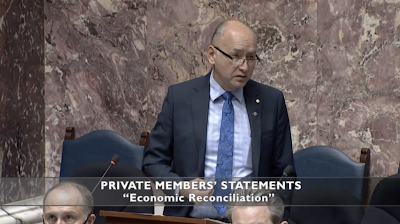
Economic Reconciliation the focus for Skeena's Ellis Ross in Monday legislature speech


Skeena MLA Ellis Ross spoke to a familiar theme for him as part of the Monday morning return to business for the BC Legislature, the MLA noting of the path ahead as he sees things towards creating the conditions for success on Reconciliation and advancement for Indigenous people.

Speaking in the early stages of the Monday session, the MLA called on some of his experiences in Kitamaat and how his Band and many others have sought to change their situations through economic development.

Today I'm here to talk about economic reconciliation. We often hear and we often talk about it, but for too long, there's been no action behind the word "reconciliation," especially in the 21st century. 

Real reconciliation means lifting people up, the most disadvantaged people in Canadian society for the last 50, 100 years — lifting them up out of poverty and putting them on a path to recovery in all its forms. As an Aboriginal member, then as a leader and now as an MLA, I've seen and continue to see the cycle continue too many times — talking about hope, talking about programs but not really giving the tools to succeed. 

And this happens all across B.C. and all across Canada. 

Our families are told to be bold, and then the dreams are stifled by indifference or mixed messages. Nothing to resolve the social issues that First Nations are facing. 

Many Aboriginal leaders, over the decade, set out to change that in a tangible way, but very few had the foundation of Aboriginal rights and title case law — specifically, the Haida court case that came out and the duty to consult in 2004. 

That year is significant. Because at that time, First Nations had a willing partner in the then government, one that was committed to action. 

Ending in 2017, that government had signed over 450 agreements with First Nations, from revenue-sharing to environment protocols to just simply engagement in protocols."

As part of his review of the recent past, Mr. Ross explored the early stages of LNG for the Haisla and the challenges that he and his leadership on the Band Council had in moving that project forward, including as he notes the work of those from afar. 

With  some politicians in the Northwest among those  he notes who tried to stop projects and vilified the elected representatives of those communities.

"There were too many doubters from 2004 to 2017 when we set out on our journey of inclusion in the economy. It started out in 2006, when we signed our first-ever forest and range agreement and then renewed it five years later — our first step into the economy and our first step in developing a partnership with the then government of B.C. 

It was really LNG that put us on the road to success and independence, not only at the elected chief and council level but where it really mattered, at the individual level, for those that had never had a real opportunity in life and were now exposed to the opportunity that a lot of Canadians had enjoyed before. 

But at the same time, there were protesters from afar who didn't like the idea and tried to stop us even before it began. Local politicians got into the act, attending rallies that vilified what we were trying to do, vilified democratically elected First Nations leaders and even signed anti-LNG declarations without even thinking of talking to the communities or even the people who were stuck in the cycle of poverty and the violence of poverty. 

Even when the outside politicians and organizations came into our communities to find discontent and played that out for their own agendas, knowing full well it would tear our communities apart right down to the family dinner table, we persevered. We stuck with it. 

When we as leaders, First Nations leaders, got threatened and called derogatory names like sellouts or apples, we stuck with it. 

We continued to battle the political agendas, the backlash, the misinformation with facts, but it was hard. It was difficult. It was one of the darkest times of our lives as First Nations leaders because of the sensationalism. The politicians, the slick messaging, the TV spokespeople were more likely to be believed than our own leadership, which was democratically elected and was expected to deliver the truth."

The discussion expanded during the course of the fifteen  minutes to explore other energy projects, how the opportunities of just a few years ago are now gone at a cost to British Columbia and Canada.
 
"The reconciliation we had envisioned was not just about First Nations. It was about so much more, based on our evolving knowledge of the economy as well as world issues, including global warming. We all know that LNG can have a positive impact on the environment of the world. We also knew what it meant to build up neighbouring towns and cities — the Lower Mainland — what it meant to government revenues that paid for hospitals, schools, roads, infrastructure and services that B.C.'ers rely on, no matter where you are. 

The cost of projects like Kitimat LNG failing is huge. Beyond the loss of jobs and capital, Canada and the world will suffer environmentally. Every year that we delay making LNG available for developing markets is another year that these growing markets remain reliant on GHG-intensive coal power, energy that is polluting our air and driving us further from our global climate goals. 

Meanwhile, Nisga'a's hydro-powered Ksi Lisims LNG will be at net zero within three years of start-up. Cedar LNG, a proposal led by Haisla Nation, will offer one of the lowest–carbon intensity LNG facilities in the world. 

We know that these projects can lift Aboriginal communities out of poverty and out of the cycles. We know that this economic reconciliation can mean more dollars to support our provincial economy. We've got to get away from the talking, and we've got to do more walking, more action. This is what reconciliation really means in terms of economics."

To close his commentary for the morning, the Skeena MLA observation observed how in the way he views it, development can be reconciled with reconciliation.

"As usual, it's talk. Not one mention of the multi-billion-dollar projects that are happening in Kitimat — one that succeeded and one that failed. 

A $30 billion Chevron KLNG project left town. That project was on reserve. That was going to provide jobs, taxes and rent to our First Nation. It's gone. 

Not one mention of Trans Mountain, the oil project that's coming through from Alberta to the shores of Vancouver. First Nations are actually actively trying to pursue equity agreements with the government of Canada. Not one mention. 

I understand that every First Nation is diverse in terms of economic goals, but their goals are the same in terms of the end game: they're trying to get to a better place in the 21st century. 

And it's not politically correct to talk about LNG. We can even talk about First Nations in the context of being stewards — an old term. 

I'd like to bring a news flash to the Legislature. I have not met one British Columbian, First Nations or not, that says: "I don't care about the environment."

 It's not just a First Nations issue in terms of the environment; it's a global issue ...

Reconciliation is the foundation of so many things happening here in B.C. 

It can uplift so many people, Aboriginals and non-Aboriginals alike. But there's a bigger picture here. We can't stay out of this game. It's called global warming. It's not called B.C. warming. It's not called Canada warming. It's called global warming. 

First Nations want to be a part of it. In fact, Eva Clayton, with her $55 billion LNG project, says the Nisga'a Nation has always been concerned about climate change and embraced the appeal of LNG as a replacement to coal and oil combustion in Asia. 

This is where the conversation has been with First Nations for the last 15 years. This is where the Legislature has got to go, this is where B.C. has got to go, and this is where Canada has got to go."

You can review the full overview of the discussion from the Legislature Hansard Record, as well as through the video archive from the Monday session, starting  at just before 10:20 AM 

For more notes on the work of the Skeena MLA at the Legislature, see our archive page here.


A look at the weather maps keeps the Northern Expedition in port for another day

A strong pacific front from the Southwest is creating
havoc for the BC Ferries schedule this week

(image from. Environment Canada)

With adverse weather continuing across the Hecate Strait, BC Ferries has announced the cancellation of its plans to attempt the Prince Rupert to Skidegate run today, that run one which had been rescheduled on Monday owing to poor weather.

As a result, the Northern Expedition will make an attempt to cross the Strait on Wednesday with a 2:30 PM departure time a return that same night at 11 from Skidegate for a Prince Rupert arrival at 6AM Thursday.

click to enlarge

However, depending on how the current pacific front system moves through the region, that sailing may itself be up for review; while the Thursday sailings are questionable as well, explained by BC Ferries as part of their Service Notice today.

"Weather is expected to be outside our safety parameters following this round trip, and the Thursday sailings departing Prince Rupert at 10:00 am and Skidegate at 10:00 pm are at risk of being cancelled. 

We will provide an update on the status of these Thursday sailings as soon as confirmation is available. We appreciate your patience and apologize for any inconvenience you may experience as a result of this service disruption. 

The safety of our passengers and crew is of primary importance to us. We don’t take the decision to cancel sailings lightly, as we know customers rely on our service to get to their destinations."

You can access updates on those sailings and other notes this week from the BC Ferries website and twitter feed.

A GALE WARNING has been in place for Hecate Strait since yesterday with winds of 45 knots anticipated for later today along with seas up to 4 metre.


More notes on Marine Transportation on the North Coast and Haida Gwaii can be reviewed here.

With Flu season on the horizon, a reminder of the importance of Flu shots

While COVID remains the main medical theme of our times and rightfully so, when considering the current impact that the coronavirus is having across Northern British Columbia. 

But while we work to bring down the rate of infection from COVID-19, another health matter is being noted, with a reminder of the need for an annual flu shot.

From Doctor Bonnie Henry, to Northern Health officials and as close as your family doctor, the need to ensure that you make time for a flu shot has been a topic of much note in recent weeks.

In a statement from the government today, Health Minister Adrian Dix outlined the importance of the province's flu shot program, which is free to all British Columbians who qualify.

“All British Columbians should get vaccinated against influenza to protect themselves and their loved ones from serious illness, to reduce the strain on our hard-working health workers and to do our part to make sure the health system continues to be there for people who need it, where they need it and when they need it. I’m grateful to all of our health-care workers, including physicians, pharmacists, nurses, nurse practitioners and others for how they help people get immunized to protect themselves and those they care about.”

Northern Health has a wealth of information on the flu season ahead through their website, with the Health Authority providing notes on the importance of a flu shot this year.

Beginning the week of October 18, 2021, seasonal influenza vaccine will be available at Public Health clinics. Influenza vaccine is recommended for everybody greater than 6 months of age.

This year, influenza vaccination is free for everyone in B.C. six months and older.

The flu vaccine for 2021-22 has been created to address four strains of concern for this flu season.
 

Locally, the flu shot will be available through local pharmacies as well as from the Northern Health Unit offices in the Ocean Centre Mall, with the most recent notice outlining the clinics at the Ocean Centre through October and early November.

Whether its through Northern Health at the Ocean Centre, or
a local pharmacy such as the one above at Save on Foods
Flu shots are available in Prince Rupert for the flu season ahead

Details of clinics to come to be relayed through the Northern Health website and Facebook page.

More notes on flu season can be reviewed from the immunizeBC website

Further health related themes for the Northwest are explored from our Health archive page.

Note: This story has been changed since its posting, to reflect that for 2021-22 the flu vaccination is free for all British Columbians six month and older, with no qualification list in place for this flu year.