Thursday, October 28, 2021

Stikine's Nathan Cullen highlights the merits he sees in Government's new Climate Change efforts

Sustainability and Climate Change were among the themes
for Stikine MLA Nathan Cullen on Wednesday at the Legislature

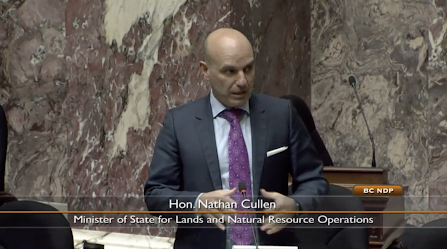
Stikine MLA Nathan Cullen had one of the key speaking roles Wednesday in defence of the recently introduced Climate Change Bill by the NDP government, the Minister of State for Lands and Natural Resources Operations providing for an extensive review of the legislation.

The Bill was introduced earlier this week by Environment Minister George Heyman with the Premier   and the Minister both outlining the scope of the CleanBC Roadmap to 2030.


“Here in B.C., the threat of climate change is no longer decades or even years away. The impacts are all around us, from devastating wildfires to intense heat waves and droughts. The scale of the climate emergency demands that we act with even greater urgency than ever before. By bringing people and businesses together, we can rise to the challenge and seize the opportunity to build a stronger, more resilient B.C. for everyone. That’s what this plan is all about.” -- Premier John Horgan.  

“By working with all sectors, we can see clearly where we are making progress and where new thinking and resources are required. The CleanBC Roadmap puts greater focus on transitioning away from fossil fuels faster and adopting clean energy solutions. It strengthens B.C.’s position to attract investment and build opportunity for British Columbians and embodies our determination and commitment to meet our climate targets.” -- George Heyman, Minister of Environment and Climate Change Strategy


Mr. Cullen opened his review of the legislation by framing it by way of responsibility  for British Columbians as well as the impact on the environment if we don't change some of our long held ways.

So what we're doing here in this bill today, I think, is important in terms of our responsibility as British Columbians — to expand the products that we are now going to limit, that will be either under a fee or banned outright, with some small and notable exceptions that I think we do need to mention. But that we will just simply not have them. 

There was great rending of garments and gnashing of teeth when it was originally suggested that the plastic straw — again, meant to last as long for as the drink lasts…. For most of us, if it's a tasty drink, it's not very long. 

But it will then go on for hundreds of years in existence and then eventually break down and end up in our food supply, sickening and poisoning future generations. But that plastic straw could be made out of something else. 

Well goodness, Speaker if you follow Twitter — and I don't necessarily advise anyone to do that, but if you do — when originally other straws that were brought onto the market, straws that we can actually make here in British Columbia…. The Ministry of Environment can talk about this as well and I'm sure has — our ability to actually create jobs with these alternatives…. 

Well, to go away from something that we were accustomed to. I get my drink. I get the plastic straw, and I know how it works. It's going to last for the duration of my time with that beverage. 

Who cares what happens next? 

Well, we do. We need to. We collectively need to. That the foam takeout container that lasts as long as it lasts until you eat those leftovers, the responsibility, once you so-called "throw it away" and it goes into the garbage, is still ours. It's still ours collectively. 

And I think the whole notion of garbage is a problematic way of thinking about things. It sort of makes it the other. Here I've got this thing and it's useful to me while I have it and as soon as it's not useful to me anymore, now it's garbage. It's somebody else's problem. 

Well we know that is no longer the right way of thinking. It's not sustainable. For somebody who lives in the North, many of our communities struggle with this responsibility: the responsibility of what happens when our citizens buy something, use something and then put it into the garbage. 

That our transfer and our dumps are filling up. They're incredibly expensive, an enormous burden on the taxpayers, over time. You just can't keep paying for these landfills.

The Stikine MLA also paid tribute to some of the leaders on the themes of climate and sustainability, including some from his own constituency, as well as to relay his own personal observations on recycling in political life.

I want to take…. I'll, perhaps, end here to the great gratitude of many in the place, with acknowledging efforts by the Minister of Environment, but also by some local leaders in my community in the northwest. 

We had lost our curbside pickup. We had a fire at the transfer station and it caused the whole domino effect within the community and we no longer had the ability, as residents in Smithers where I live, to be able to bring things down to curbside as most British Columbians, most Canadians do. 

Our regional director representative Mark Fisher, our local mayor Gladys Atrill, were incredibly persistent — and the Minister of Environment can confirm this if he chooses to — in rethinking the way that we were doing recycling in the northwest, because we have these challenges. 

Any of the rural or remote communities have the great distances to collect the material, send them on and get them somewhere useful so that they can be reused and repurposed. 

These two local leaders were incredibly motivated and dedicated and it was with great excitement when we could, once again, take our recycled materials, recyclable materials down to the curbside. I know it doesn't sound like a great thing, but it was remarkable to me because it was soon after the most recent election a year ago where we engaged in this project. 

Interestingly, it was one of the collective reasons I stepped back into politics. I left federal politics and folks were coming to me with these challenges like this one. It might seem small to people watching, but it mattered to us, and a bunch of other cases, sitting in coffee shops with people in Smithers, saying how are we going to fix this?  The system is not quite working for us in rural B.C. 

So I would try to phone in. I can remember contacting the minister's staff and saying is there anything we can do about this? Someone said you should run again and just do this all the time, because you enjoy it. We all believe in recycling, repurposing. It's really important not to simply throw things away, be they products or people. 

And I guess folks in the northwest thought that recycling was okay, because a year ago, with great gratitude to the folks in Stikine, I was re-elected to public office, which is an incredible honour and privilege. 

Every day you get to walk into a place like this and attempt as best as you can to represent the voices and concerns of people in your constituency. What we're doing here today on Bill 24, it is good to hear of support from across the way, to continue the work and to understand that it's iterative. That it's not perfect and not done. You continue to seek a better solution to the challenges that we face. But, similar to that campsite that we find, always try to leave it better than we found it. 

We as a generation, as generations, have been unable to make that promise to future generations to this point. We're trying and we're getting better, but when we all visit those schools and we talk to those kids and we say, you're the future, we have hope in you, you're who we're leaving this behind to, and inevitably one of those will say, well what are you doing about climate change? What are you doing about the forests?  What are you doing about the garbage that we see? 

Those are the voices that must compel us and motivate us that see these systems that were built improperly, incorrectly, without considerations of their sustainability and to make them better. 

And that's what we're doing with this bill. I'm very happy to support it.

The full text of Mr. Cullen's fifteen minute presentation can be reviewed in full from the Legislature Archive page here, starting at the 3:45 PM mark.


Some background the program can be examined here.

For more notes on the work of the MLA at the Legislature see our archive page here.


Dive into the Employment Pool, with the City of Prince Rupert


The quest for lifeguards is on for the City of Prince Rupert, a challenge for many communities these days, with reports of labour shortages requiring some nifty navigation of pool scheduling across the province.

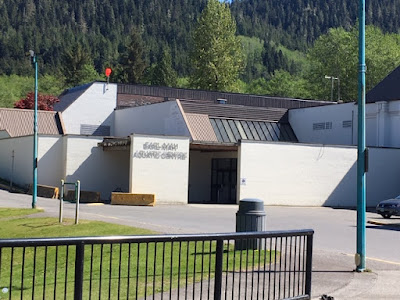
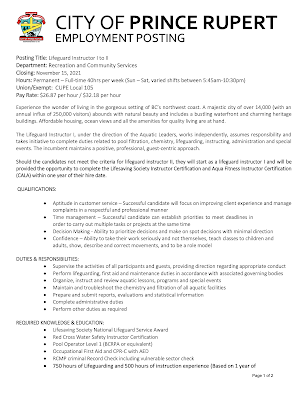
Towards the local need, the City of Prince Rupert has posted a Job Opportunity for the Earl May Aquatic Centre, seeking the services of a Lifeguard Instructor I to II, a full time position which pays a rate from $26.87 to $32.18 per hour.

The background notes o the opportunity looks as follows:

The Lifeguard Instructor I, under the direction of the Aquatic Leaders, works independently, assumes responsibility and takes initiative to complete duties related to pool filtration, chemistry, lifeguarding, instructing, administration and special events. The incumbent maintains a positive, professional, guest-centric approach. 

Should the candidates not meet the criteria for lifeguard instructor II, they will start as a lifeguard instructor I and will be provided the opportunity to complete the Lifesaving Society Instructor Certification and Aqua Fitness Instructor Certification (CALA) within one year of their hire date.

The full scope of what the City's Recreation Department is looking for can be reviewed below:


click to enlarge

Resumes and cover letters can be directed to Ashley Daigle, Recreation and Community Services Manager for the City of Prince Rupert. 

1000 McBride Street Prince Rupert, BC V8J 2H3 
Email: hrrec@princerupert.ca Fax: 250-627-8036

The Deadline to apply is November 15th.

More notes on past City of Prince Rupert employment opportunities can be reviewed here.

Chaotic night on West side streets ends with suspect arrested and facing multiple charges


Some road chaos made for an eventful night on the city's west side Wednesday as reports of an erratic driver made their way to the Prince Rupert Detachment of the RCMP.

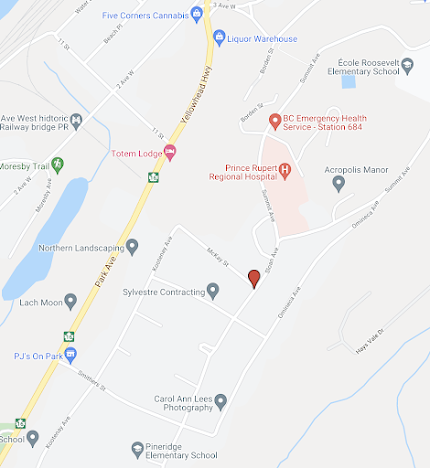
Members from the RCMP, along with the Prince Rupert Fire/Rescue department were dispatched to the area of Sloan and McKay street just after 10PM

The emergency response coming following reports of Black Ford truck travelling at high speed, through the area, eventually knocking down a street light post as the truck concluded its journey at McKay.

The male driver fled the scene and thanks to help from a number of witnesses in the area was subsequently tracked down by the Mounties on Smithers Street. 

Waking the neighbours was a thing on Wednesday evening
as a motorist took out a street light at the corner of
McKay and Sloan on the west side

Now in custody, the un-named driver, now faces a range of charges related to the incident, which include impaired operation with 80mg of blood alcohol content, obstruction to a police officer and dangerous operation.

He will face a court date in the near future to face the allegations and charges as a result of the incident.

For more notes related to Emergency Responders across the Northwest see our archive page here.

Long Overdue recognition for Prince Rupert educator and community Arts icon Alison O'Toole

They're bursting with pride and deservedly so at Charles Hays Secondary, with the celebrations extending throughout the Prince Rupert School District and among the thriving theatre community in town this week. 

That as Alison O'Toole the long serving Drama teacher and community arts advocate was named Drama Teacher of the Year by the BC Drama Educators Association.

The Prince Rupert School District outlined how the long overdue award came to make its way to the North Coast earlier this week, with a Social media post that charted the nomination process and eventual award.


The Award serves to pay tribute to Ms. O'Toole's impact not only on education with SD52, but towards theatre as part of the community fabric.

The driving force behind the energetic Drama program at Charles Hays Secondary, the yearly production has long been one of the must attend Community events for Prince Rupert. 

The three show run each year providing a showcase of the vast talents at Charles Hays, skillfully drawn out by their Teacher who shepherds each presentation to the final curtain call. 

From that launching pad, many of her students have gone on to continue with their theatrical pursuits whether in community theatre in Prince Rupert or through further studies at university or college. 

And for them, the award for the woman that launched their draw to drama is surely one they will welcome, though perhaps with a note of 'what took so long'


The Awards this year took place as part of the ABCDE virtual conference, the award outline providing a snapshot of what the panel looks for as they celebrate excellence in teaching in the drama genre

This award is for an exemplary teacher and ABCDE member. It may go to anyone who teaches K-12 and incorporates Drama in and beyond the classroom, such as touring shows to other schools, going to see other people's theatrical work, having professionals in the school working with students

All elements that the Charles Hays educator has long excelled at, as the countless tributes from former students can attest to.

The Association has not as of yet updated their Awards page, but once they do, the Charles Hays teacher will join the ranks of the honourees from this portal.

The scope of her talents have taken the popular CHSS Teacher to the local community theatre collective as well, Ms. O'Toole a frequent figure on the stage of the Lester Centre of the Arts in the past from a variety of community productions that have brought together all of the theatrical and musical community over the years.

And now that the theatrical community is starting to stir again, theatre goers in Prince Rupert and the region will once again be looking forward to hearing of the latest production from Charles Hays, or what big plans the local theatre community is ready to reveal when the curtain goes up once again.

The salutes to Ms. O'Toole can be found from many Social Media platforms over the last few days, the largest volume so far those found from  Prince Rupert Mayor Lee Brain's Facebook page, as he and many residents of the community joined in to share their congratulations on the welcome news.

More notes on Education can be reviewed here.

A wider look at the Arts Scene in Prince Rupert can be found here


MLA's Rice, Ross explore discussion themes on Indigenous education at Legislature


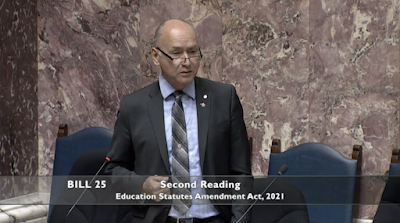
The members of the British Columbia Legislature have been debating and discussing elements of Bill 25, the Education Statutes Amendment Act which has been introduced by the NDP government, legislation that will amend the First Nations Education, the Teachers Act and the Criminal Records Review Act.

Much of the debate to date from members has been focused on the elements related to change for First Nations education, among those participants have been North Coast MLA Jennifer Rice and Skeena MLA Ellis Ross who both spoke to the topic this week in the Legislature.


Mr. Ross led off the northwest review on Tuesday afternoon, with the MLA again raising his previous concerns over how he views the Province's consultation approach with the 203 First Nations across the province.

I had to get up and speak to Bill 25, the Education Statutes Amendment Act, 2021, that — amongst other things — actually promotes the ability of the province to come onto reserve and certify teachers on reserve. That's quite the complicated question, because on reserve, as we know, the province, in most cases, is not welcome. 

It's federal jurisdiction. You have to be invited specifically to come onto reserve to implement anything provincial. In this case here, I never really had any issue with the objective of certifying teachers on reserve. In fact, many schools across Canada could use the certification that we're talking about in this House. 

The issue I take, though, is that there's some misunderstanding that chiefs and councils don't already have this authority. 

They could pass a bylaw. They could pass their own law right now, with or without the Indian Act. With or without Bill 25, they can do this. That power and authority already exists.

Mr. Ross then explored some of the elements of the act and what it seeks to address.

The local education agreement can be strengthened, I agree. If this bill, Bill 25, actually mentions that and actually enables both sides of the table to actually enact a really strong local education with the First Nation and the local school district, more power to the First Nations. 

Good. It's a long time coming. But I don't understand the issue of the certification of teachers on reserve when First Nation councils already have that authority. They can do it without the province. They can do it without Bill 25. 

And in terms of the consultation we talked about — this is an old theme I've talked about — this government has actually contradicted and breached its own law that it passed in this House in terms of UNDRIP, Bill 41, which they like to talk about in terms of reconciliation. 

The bill, that UNDRIP promised by the NDP government, said they would consult the leaders and the rights and title holders of B.C. 

We haven't seen one example of that yet. All we hear is how this government has consulted advocacy groups that do not represent the opinions of British Columbia's First Nations communities — the leadership council, or administrative bodies that do not represent the communities of First Nations. 

Rights and title holders are actually the community members, so it only stands to reason that the rights and title holders that you should be negotiating with are those leaders that are selected by their communities to represent them. 

Not once have I heard any legislation come through this House that actually recites the consultation that was done with 203 First Nations. 

And It sounds to me like Bill 25 failed to deliver that as well. You're breaking your own law.

The wide ranging address covered a number of themes, including how the government is taking an approach of reconciliation towards its plans, something that the Skeena MLA had a few more thoughts on.

There has been a lot of work being done ever since 2004, especially around reconciliation. Reconciliation has been happening in B.C. since 2004, regardless of what you think 

Because I was on the other side of that table actually helping implement it. 

Reconciliation did include education. I did agree with that. But more importantly, it had an economic component to it that actually resolves a lot of the issues that we like to talk about, the social issues of Aboriginals. 

So, I look forward to more speeches, but I do ask the government to keep it in perspective. It is not the silver bullet that you proclaim it to be.


You can review the full text of his Tuesday presentation from the Legislature Archive, while the video of the Session is available here, both elements start at the 6 PM mark.


North Coast MLA Jennifer Rice entered the debate as part of the Wednesday session, Ms. Rice directed much of her attention on how the legislation will change the current approach for education in Indigenous communities.

Education can and must play a key role in reconciliation, and in creating equity and justice. That's why I'm happy to stand today and speak to Bill 25, the Education Statutes Amendment Act, which is about making legislative changes to support First Nations jurisdiction over education. 

These legislative changes and their joint development are concrete steps in implementing the province's reconciliation commitments to advance education outcomes for Indigenous students, and work in partnership with Indigenous peoples. 

These changes are in line with our commitments under DRIPA, the Declaration on the Rights of Indigenous Peoples Act, and in line with the calls to action from the TRC, the Truth and Reconciliation Commission's, calls to action. 

In partnership with FNESC, the First Nations Education Steering Committee, we have announced legislative changes to amend the First Nations Education Act, the Teachers Act and the Criminal Records Review Act. 

First Nations that are participating in the initiative will soon be able to certify and regulate teachers working in their schools. 

And the legislative changes introduced will enable the province to provide operational support. 

The legislation will also change the composition of the B.C. Teachers Council, the provincial body whose responsibilities include establishing certification, conduct and competence standards for provincial teaching certificate holders. 

The changes will ensure representation on the B.C. Teachers Council by the soon-to-be created First Nations Education Authority, which is the body that will be made up of individuals appointed by First Nations participating in this initiative.

Ms. Rice, called attention to some of the past history of education in Indigenous communities, sharing observances on concerns of not too long ago for a community in the North Coast riding, Bella Bella. 

The MLA making note of the work of educator Anita Hall towards improving education for the coastal First Nation Heiltsuk community.

I want to take a moment to highlight an educational leader in Bella Bella. Anita Hall is a longtime teacher and now principal in this school. She's a strong Indigenous woman, leading the school in a very powerful way. She's also a skilled teacher. Her students, like many students, come into her classroom at different reading levels. By the end of every year, every one of her students is reading at grade level. 

She's a literacy expert, a learning expert and now principal and, just recently, a B.C. Achievement Foundation community award recipient. Anita believes wholeheartedly in the ability of those around her to succeed. As the elementary principal at Bella Bella Community School, she has created a place where students feel safe and included. 

She exemplifies what a decolonial and community-rooted approach to education can look like. Through her vision, students thrive both academically and personally. Under her leadership, and in spite of the challenges that COVID presented, Anita has shaped a community school to which Bella Bella youth want to belong. 

At Bella Bella Community School, 65 percent of the staff are Indigenous, and most of them are HáiÉ«zaqv, which makes a significant difference. Research shows that Indigenous learners learn better from Indigenous teachers, because they have similar cultural touchstones. 

At Bella Bella Community School, culture and academia are intertwined. There is no separation. 

My friend Ila Brown describes the school by saying: "We don't create the split; we harmonize them." 

She notes that they have very high graduation rates because children do feel safe in their school. They are student-centred, because the Háiɫzaqv way is to be child-centred. Children are the very centre of the community.

An important takeaway from the Bella Bella school program is that people don't have to choose between being HáiÉ«zaqv and being an academic student. They bridge western ways of knowing and HáiÉ«zaqv ways of knowing. And bridge these worlds. They can be the same world.

I wholeheartedly support the amendments proposed in Bill 25 to support First Nations in B.C. to have autonomy over their own education systems and to see incredible success stories, like the Bella Bella Community School.

As was the case with Mr. Ross, the North Coast MLA's contribution to the discussion can be reviewed from the Legislature Archive page, and viewed through the Legislature Chamber Video archive, both elements begin at just after 2:45 PM

More notes on the work of the MLA's in the Legislature can be reviewed below


Themes related to education across the Northwest can be explored here.


City of Prince Rupert seeking members for Airport Board

An opportunity to help guide the future for the Digby Island Airport is available once again, with another call for applications for  Directors  for the Prince Rupert Airport Authority Board.

The application period for the available positions ends on November 5th, with those interested in the posts invited to submit their letters of interest by that date.

As has been the case with many of the City's past Board opportunities, the City will consider applications with the following in mind:

The City appoints to our committees on the basis of merit and is strongly committed to equity and diversity within our community. We especially welcome applications from visible minority group members, women, First Nations persons, persons with disabilities, persons of minority sexual orientations and gender identities, and others with the skills and knowledge to productively engage with diverse communities. All qualified candidates are encouraged to apply. 

Applications for the board positions are to be directed to Rosamaria Miller the City's Corporate Administrator, 2nd Floor, City Hall, 424 - 3rd Avenue West,  rosamaria.miller@princerupert.ca

If you require more information on the call for applicants contact the Corporate Administrator at 250-627-0934

It's a timely moment for new Board members to come aboard, as has been relayed through the year at City Council, revenue streams are down significantly for the Airport Ferry and with reduced service for the airport, landing fees and other revenue streams have also been impacted by the times of COVID.

As candidates consider their prospects of service, the Airport has also seen the departure of now former Airport Manager Rick Leach, though City Council has not made mention of that departure, or what the plan moving forward for leadership at the airport may be.

The Prince Rupert Airport Authority is composed of the Mayor of Prince Rupert, the City Administrator and the City Council. The eight Directors of the Authority who oversee the operations of the airport are appointed by the City and sit for a term of two years.

You can learn a bit about the Airport Authority, from their website, though the information from that portal has not been updated for a while now.

More notes on aviation in the community can be explored here.

Further notes on items of interest from City Hall can be reviewed here.


Wednesday, October 27, 2021

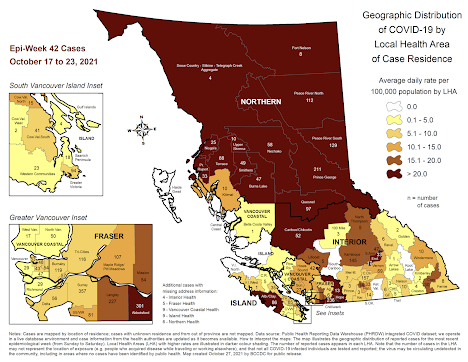
Prince Rupert area spikes in COVID Count from CDC Figures to October 23


Terrace continues to top the listings for the Northwest, but there are two new areas of note reporting in this week from the latest data from the BC CDC.  

The Terrace region shows another jump upwards, of 17 cases, with 88 cases listed this week, up from  the 71 cases recorded last week.

Also finding  a bit of a spike is the Nisga'a region, which has increased to 25 cases counted up from nine cases one a week ago.

Prince Rupert saw a increase over the last seven days as well , with a count of 33 cases as of October 23rd, an increase of 20 from the 13 cases noted last week.

By comparison Smithers has seen a decline for the last seven days with this weeks numbers marked at 49, a reduced level from last weeks 58 cases.


The full review across the region looks as follows:

Terrace -- 88 cases
Nechako -- 58 cases
Smithers -- 49 cases
Burns Lake -- 47 cases
Prince Rupert -- 33 cases
Nisga'a Region --  25 cases
Upper Skeena --  10 cases
Kitimat --
 10 cases 
Snow Country-Stikine- Telegraph Creek --
 4 cases
Bella Coola Valley --
 1 case
Haida Gwaii -- 0 case
Central Coast -- 0 cases


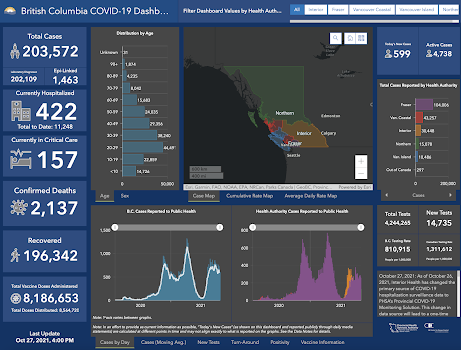
Wednesday's provincial report lists  130 new cases for Northern Health,  with 808  Active cases.

There are currently 79 residents of the North hospitalized from COVID , with 22 listed as requiring Critical Care.

BC CDC COVID data results for Wednesday October 27, 2021


The full report from the Province for Wednesday can be accessed here.  

The larger BC CDC Data release is available here.

Past information statements on COVID and other notes on the Northwest response can be reviewed from our archive page.